Why Doing Nothing About Estate Planning Might Actually Make Things Worse
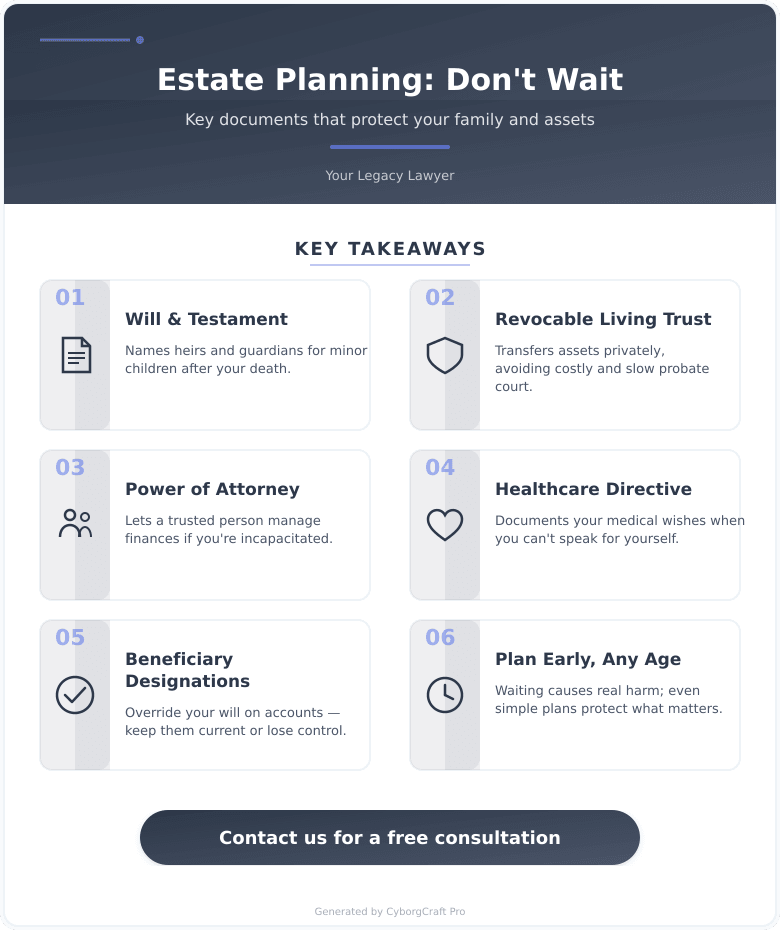
This guide focuses specifically on what estate planning covers, who needs it, and how to know when your plan needs an update.
Estate Planning Definition: Estate planning is a structured legal process that uses documents like wills, trusts, powers of attorney, and healthcare directives to control how your assets are managed and distributed during life and after death.
Most people assume estate planning is for retirees or the wealthy. That assumption causes real harm. When someone dies without a plan in Georgia, state intestacy laws decide who gets what, and those decisions rarely match what the person actually wanted. The most common mistake we see is waiting too long to start, then scrambling after a health crisis makes planning harder.
What Estate Planning Actually Covers
Estate planning is not just a will. A complete plan typically includes several coordinated documents, each serving a distinct purpose.
Will (Last Will and Testament): A legally binding document that names who inherits your assets and, critically for parents, who becomes guardian of minor children.
Revocable Living Trust: A legal arrangement where a trustee manages assets during your lifetime and transfers them to beneficiaries without going through probate court.
Durable Power of Attorney: Authorizes a trusted person to handle financial decisions on your behalf if you become incapacitated.
Healthcare Directive (Advance Directive): Documents your medical preferences and names someone to make healthcare decisions if you cannot speak for yourself.
Beneficiary Designations: Separate from your will, these forms attached to retirement accounts and life insurance policies often override everything else you have in writing.
Estate planning professionals commonly observe that many estates end up in probate because beneficiary designations were outdated or missing, not because the person lacked a will.
Do I Need an Estate Plan If I’m Young?
Yes. Here’s the honest answer: age has very little to do with it. What matters is whether you have people who depend on you, assets you care about, or opinions about your own medical care.
Consider what happens without a plan in Georgia:
- Georgia’s intestacy laws distribute your property through a default formula that may leave out unmarried partners, close friends, or causes you supported
- Without a healthcare directive, family members may face agonizing decisions with no guidance from you
- Minor children could have their inheritance managed by a court-appointed guardian you never would have chosen
- Your digital assets, business interests, and accounts held in your name alone go through probate, which is public record
A significant number of Americans have no estate plan at all. The thinking is usually “I’ll get to it later.” But later has a way of arriving at the worst possible time.
If you’re young, single, and renting with no dependents, your plan can be simple: a will, a healthcare directive, and updated beneficiary designations. That might take a few hours and a modest flat fee. Thinking about this for your situation? Let’s talk. Contact us and we’ll walk you through your options with no pressure.
Revocable Trust vs. Will: Which Approach Works?
Where a Will succeeds: Straightforward to create, names guardians for minor children, works well for smaller or simpler estates.
Where a Will fails: Goes through probate (public, slow, costly), offers no protection during incapacity, and provides no privacy.
Where a Revocable Trust succeeds: Avoids probate entirely, takes effect immediately upon incapacity, keeps asset transfers private, and can manage assets across multiple states.
Where a Revocable Trust fails: Costs more upfront to create, requires active funding (you must re-title assets into the trust), and doesn’t replace a will entirely since a pour-over will is still needed.
The verdict: For most Georgia families with a home, retirement accounts, and young children, a revocable trust paired with a pour-over will offers the most protection. Simpler situations may do fine with a will alone. The right choice depends on your specific assets and family structure.
| Document | Avoids Probate | Works During Incapacity | Typical Cost Range (2026) | Best For |
|---|---|---|---|---|
| Will alone | No | No | $300 – $800 | Simple estates, naming guardians |
| Revocable Trust + Pour-Over Will | Yes | Yes | Varies by complexity and attorney | Homeowners, blended families, privacy needs |
| Full estate plan package | Yes | Yes | Varies by complexity and attorney | Complex assets, business owners, high net worth |
Note: These are general industry cost ranges for Georgia, not fees charged by any specific firm. Actual costs vary by complexity and attorney.
How Often Should You Update Your Estate Plan?
Your estate plan is not a one-time task. Life changes, and your documents need to keep up. A plan that was perfect five years ago may actively work against your wishes today.
Review and potentially update your plan after any of these events:
- Marriage, divorce, or remarriage
- Birth or adoption of a child or grandchild
- Death of a named beneficiary, executor, or trustee
- Significant change in assets (buying a home, receiving an inheritance, selling a business)
- Moving to a different state
- Major changes in tax law
As a general rule, review your plan every three to five years even if nothing major has changed. Tax thresholds shift, Georgia statutes get updated, and your own priorities evolve. Firms that implement regular reviews typically catch outdated beneficiary designations before they become a court problem.
For Georgia residents in the Atlanta area, including communities throughout Cobb County, Fulton County, Cherokee County, and surrounding areas, state-specific rules around probate and advance directives mean local guidance matters. Your Legacy Lawyer serves clients across the greater Atlanta metro and understands how Georgia courts handle estate matters.
Your Estate Planning Action Plan
- Step 1 – Take inventory: List your assets, accounts, and existing beneficiary designations. Note any that are outdated or missing.
- Step 2 – Identify your people: Decide who you trust to serve as executor, trustee, healthcare proxy, and guardian for minor children.
- Step 3 – Choose your documents: Based on your situation, determine whether a will alone or a trust-based plan makes more sense.
- Step 4 – Work with an attorney: Georgia has specific execution requirements for wills and trusts. Documents that don’t meet those standards can be challenged or voided.
- Step 5 – Fund your plan: If you create a trust, re-title assets into it. Update beneficiary designations on all accounts.
- Step 6 – Store and share: Keep originals somewhere secure. Tell your executor and healthcare proxy where to find them.
Common Mistakes That Derail Estate Plans
- Not funding the trust: Creating a trust and then never moving assets into it means those assets still go through probate.
- Ignoring beneficiary designations: An ex-spouse listed on a 401(k) can override everything in your will.
- Using online templates without legal review: Generic documents often fail Georgia’s specific witnessing and notarization requirements.
- No plan for digital assets: Email accounts, cryptocurrency, and online banking require specific authorization language to transfer.
Ready to take the next step? Contact us today for straight answers and real solutions. Our team helps Georgia families build plans that actually hold up when it matters most.
Key Takeaways for Georgia Families in 2026
- Estate planning is not just for the elderly – any adult with assets, dependents, or healthcare preferences needs a plan
- A will alone is not always enough – trusts, directives, and beneficiary designations work together as a complete system
- Georgia intestacy laws fill the gap if you don’t – and they may not reflect your wishes
- Plans need regular reviews – every three to five years or after any major life change
- Beneficiary designations can override your will – keeping them current is as important as the documents themselves
Frequently Asked Questions
What is estate planning in simple terms?
Estate planning is the process of deciding in advance who gets your assets, who makes decisions for you if you can’t, and how your wishes are carried out legally. It uses documents like wills, trusts, and powers of attorney to make those decisions binding and clear.
Do I need an estate plan if I’m young and don’t have much money?
Yes, even a basic estate plan matters if you’re an adult, because incapacity can happen at any age and someone needs legal authority to help you. A simple will, healthcare directive, and updated beneficiary designations can be done affordably and provide real protection.
How often should you update your estate plan?
Review your estate plan every three to five years and after any major life event like marriage, divorce, a new child, or a significant change in assets. Outdated documents are one of the most common causes of estate disputes and unintended outcomes.
What happens if I die without a will in Georgia?
Georgia’s intestacy laws distribute your assets according to a fixed statutory formula, which may not match your actual wishes. Your estate will go through probate court, and the process can take months or longer depending on complexity.
What is the difference between a will and a trust?
A will takes effect only after death and must go through probate, while a trust can manage assets during your lifetime and transfer them privately without court involvement. Many families use both together for complete coverage.
How much does estate planning cost in Georgia?
Basic estate plans in Georgia generally start around $300 to $800 for a simple will-based plan, while trust-based plans vary more widely depending on complexity. These are general industry ranges as of 2026 and actual fees vary by attorney and situation.
Can I do my estate plan online without an attorney?
Online templates carry real risk in Georgia because state law has specific requirements for valid execution that generic documents may not meet. A document that fails those requirements can be challenged in court, which often costs far more than working with an attorney from the start.
What documents do I need to bring to an estate planning consultation?
Bring a list of your assets and account numbers, existing beneficiary designation forms, any prior estate planning documents, and the names and contact information for people you’d name as executor, trustee, or guardian. The more organized you are, the faster and more accurate your plan will be.
What This Means for You
Estate planning is one of those things that feels easy to postpone because nothing urgent is pushing you toward it today. But the families who avoid court delays, family disputes, and financial losses are the ones who planned before a crisis hit. Georgia law gives you real tools to protect the people you care about. Using them is a straightforward decision.
For more information about how Your Legacy Lawyer approaches estate planning for Atlanta-area families, visit our services page or get in touch to schedule a consultation. We serve clients throughout Cobb County, Fulton County, and surrounding Georgia communities.
Disclaimer: This content is for general informational purposes only and does not constitute legal advice. For guidance specific to your situation, consult a licensed Georgia attorney.