What Georgia Law Does With Your Assets When You Die Without a Will
Dying without a will in Georgia means the state steps in and distributes your assets according to a fixed legal formula called intestate succession. Most people assume their spouse or children will automatically receive everything – but Georgia law may have different plans.

This guide focuses specifically on how Georgia’s intestacy laws affect surviving family members and what assets are at risk when no valid will exists.
Intestate Succession Definition: Intestate succession is the legal process by which a deceased person’s assets are distributed according to state law when they die without a valid will, with Georgia’s rules codified under O.C.G.A. § 53-2-1.
The most common mistake families make is assuming the law mirrors their loved one’s wishes. It rarely does. Georgia’s intestacy statute follows a strict hierarchy – and that hierarchy can produce outcomes that feel deeply unfair to the people left behind. Working with Your Legacy Lawyer before that moment arrives can change everything.
How Georgia’s Intestate Succession Law Actually Works
Under O.C.G.A. § 53-2-1, Georgia distributes assets based on the surviving relatives a deceased person leaves behind. Here’s how the hierarchy breaks down:
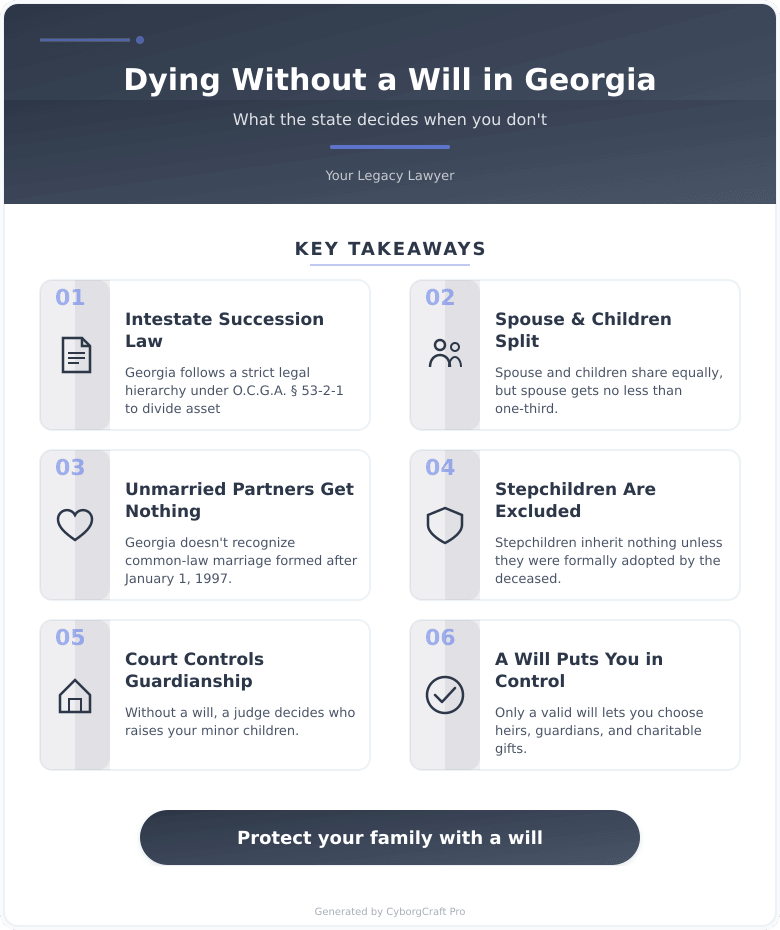
- If you have a spouse and children: your spouse and children share your estate equally – but your spouse receives no less than one-third
- If you have children but no spouse: children divide everything equally
- If you have a spouse but no children: your spouse inherits everything
- If you have no spouse or children: assets pass to your parents, then siblings, then extended relatives
- If no living relatives exist: your estate escheats (reverts) to the State of Georgia
Notice something? Unmarried partners, stepchildren, and close friends receive nothing under this formula – regardless of how long you shared your life with them.
Dying Without a Will in Georgia: Who Gets Left Out
This is where Georgia intestacy law surprises most people. The state’s formula is mathematically precise but emotionally blind.
Unmarried partners: No matter how long two people have lived together, Georgia does not recognize common-law marriage formed after January 1, 1997. Your partner of 20 years could walk away with nothing.
Stepchildren: Unless formally adopted, stepchildren are not legal heirs under Georgia intestate succession. A biological child you barely knew could inherit before a stepchild you raised.
Estranged relatives: A sibling or parent you haven’t spoken to in decades may be entitled to a share of your estate if you die intestate with no closer heirs.
Recent data shows that nearly 60% of American adults do not have a current will – and the consequences fall hardest on blended families and unmarried couples. If your situation includes any of these relationships, the stakes of dying without a will in Georgia are especially high.
Thinking about what this means for your family? Contact us for a straightforward conversation about your options. No pressure, no jargon.
Intestate Succession vs. Having a Valid Will: A Direct Comparison
| Factor | Dying Intestate (No Will) | Dying With a Valid Will |
|---|---|---|
| Who decides distribution | Georgia state law | You decide in advance |
| Unmarried partner inheritance | Not eligible | Can inherit any amount |
| Stepchildren | Not eligible unless adopted | Can be named as beneficiaries |
| Charitable gifts | Not possible | Fully supported |
| Guardian for minor children | Court decides | Parent nominates preferred guardian |
| Probate timeline (general) | Often longer, more contested | Generally faster with clear direction |
| Estate cost impact | Higher administrative costs typical | Lower when properly structured |
Where intestacy fails most clearly: Blended families, unmarried couples, and anyone with specific wishes about charitable giving or guardianship for minor children.
Where intestacy might be acceptable: Very rarely – only in cases where someone has no assets, no relationships outside the biological family, and no preferences about guardianship.
The verdict: For nearly every Georgian with any assets or meaningful relationships, dying intestate produces worse outcomes than even a simple, inexpensive will.
Your Intestate Succession Action Plan
- Step 1 – Inventory your assets: List everything you own – bank accounts, real estate, vehicles, retirement accounts, and life insurance. Understand which assets pass through probate and which transfer by beneficiary designation.
- Step 2 – Map your family relationships: Identify anyone you want to protect who falls outside Georgia’s intestate hierarchy – partners, stepchildren, close friends, or charities.
- Step 3 – Review beneficiary designations: Retirement accounts and life insurance transfer by contract, not by will or intestacy law. An outdated beneficiary form can override everything else.
- Step 4 – Consult a Georgia attorney: Georgia has specific execution requirements for valid wills (O.C.G.A. § 53-4-20). A will signed without proper witnesses is invalid and your estate still passes under intestacy rules.
- Step 5 – Revisit after major life changes: Marriage, divorce, a new child, or a significant asset acquisition each create new gaps your plan needs to address.
What the Georgia Probate Court Process Looks Like
When someone dies intestate in Georgia, the probate court appoints an administrator (rather than an executor named in a will) to manage the estate. That person is typically the closest surviving relative – but family members can disagree, creating delays and conflict.
Intestate estates commonly take longer to close than testate estates, partly because the court must verify the family tree before distributing anything. Add a dispute among relatives and timelines stretch further.
The most common pattern we see in these situations: families who got along fine while their loved one was alive spend months – sometimes years – tangled in court because no written instructions existed.
For Atlanta-area families navigating this process, Your Legacy Lawyer works with clients across Cobb County, Fulton County, DeKalb County, Cherokee County, and surrounding communities including Marietta, Smyrna, Sandy Springs, Alpharetta, and Decatur.
Key Takeaways for Georgia Residents in 2026
- Georgia intestacy law follows O.C.G.A. § 53-2-1 – a rigid formula that ignores personal relationships outside the biological family
- Unmarried partners and unadopted stepchildren receive nothing under Georgia’s default rules
- Minor children’s guardianship goes to a court’s determination, not your preference, if you die without naming a guardian
- Beneficiary designations on financial accounts override both wills and intestacy law – review them annually
- Valid Georgia wills require specific execution steps – a handwritten note or unsigned document will not protect your family
Frequently Asked Questions
What does dying without a will in Georgia actually mean legally?
Dying without a will in Georgia means your assets are distributed under O.C.G.A. § 53-2-1, Georgia’s intestate succession statute, with no input from you. The court appoints an administrator, identifies legal heirs based on bloodline and marriage, and distributes assets accordingly – regardless of your actual wishes.
Does my spouse automatically get everything if I die without a will in Georgia?
Not necessarily – if you have children, your spouse shares the estate equally with them under Georgia intestacy law. Your spouse receives at least one-third, but the rest divides among your children, which can create practical complications for a surviving spouse.
Can a long-term unmarried partner inherit under Georgia intestacy law?
No – Georgia does not recognize common-law marriages formed after January 1, 1997, so an unmarried partner has no inheritance rights under intestate succession. Without a valid will naming that person, they could receive nothing from your estate.
What happens to my minor children if I die without a will in Georgia?
A Georgia probate court will determine guardianship for your minor children if you have no valid will nominating a guardian. The court considers the child’s best interests, but the final decision rests with a judge – not with the person you would have chosen.
How long does intestate probate take in Georgia?
Intestate probate in Georgia typically takes 12 to 24 months, though contested estates or those with complex assets can take longer. Having no will adds steps – the court must verify heirs before distributing anything, which extends the process.
Are retirement accounts and life insurance affected by intestate succession?
No – retirement accounts, life insurance policies, and payable-on-death bank accounts transfer directly to named beneficiaries, bypassing both wills and intestacy law entirely. This makes keeping beneficiary designations current one of the most important financial tasks you can do right now.
What is the difference between an executor and an administrator in Georgia?
An executor is named in a will and approved by the court, while an administrator is appointed by the probate court when someone dies intestate. Administrators are typically the closest surviving relative, but family disputes over who should serve can delay the entire process.
Your Next Step
Georgia’s intestate succession rules exist because the state needs a default system – but that system was never designed to reflect your specific life, relationships, or values. The gap between what the law assumes and what you actually want is exactly where families get hurt.
Ready to close that gap? Contact us today for a clear, no-pressure conversation about where you stand. The team at Your Legacy Lawyer, serving Atlanta and the surrounding Georgia communities, can walk you through what a valid, properly executed will means for your specific family. For a full overview of how we can help, visit our services page.
Don’t let state law write the ending to your story.