Red Flags That Mean You Need a Durable Power of Attorney Immediately
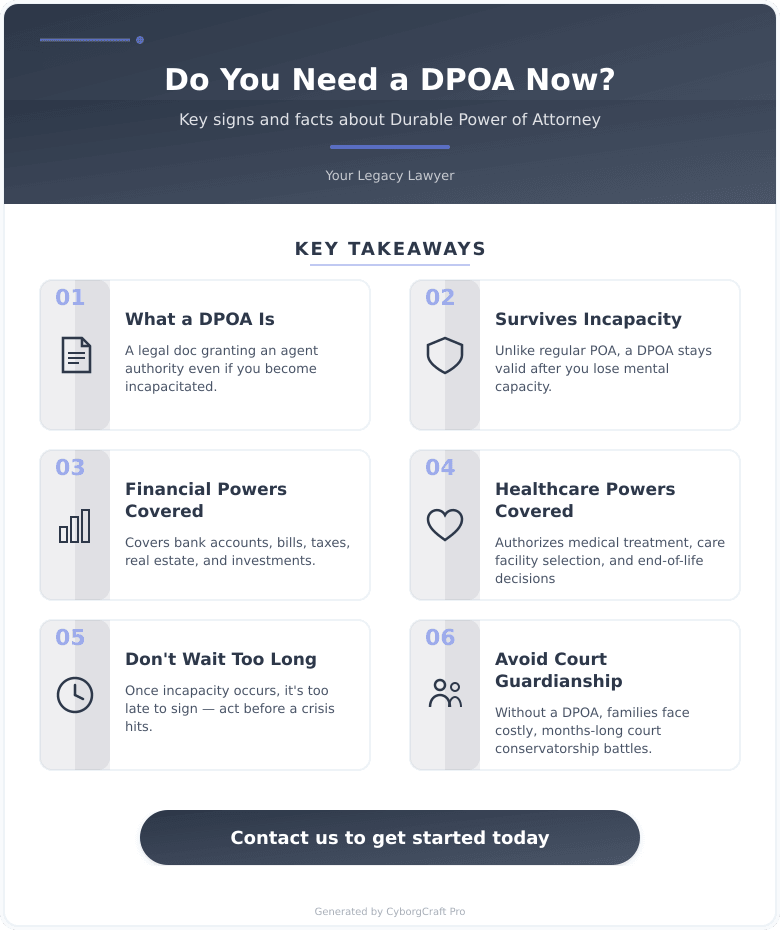
This guide focuses specifically on what a durable power of attorney is, how it works in Georgia, and what happens to your family if you don’t have one in place.
Durable Power of Attorney Definition: A durable power of attorney (DPOA) is a legally binding document granting a designated agent broad or limited authority to act on your behalf in financial, legal, or healthcare matters, and that authority remains enforceable even if you become incapacitated.
Most people assume they don’t need a durable power of attorney until they’re older. That assumption causes real problems. Accidents, sudden illness, and unexpected medical events happen at every age – and without a DPOA in place, your family may have no legal authority to manage your accounts, pay your bills, or make medical decisions on your behalf.
The most common mistake we see is people waiting too long. Once incapacity happens, it’s too late to sign a power of attorney. At that point, your family typically has to pursue a court-ordered guardianship or conservatorship – a process that takes months, costs thousands of dollars, and puts your personal affairs in front of a judge.
What a Durable Power of Attorney Actually Covers
A DPOA can be broad or limited in scope, depending on what you authorize. In Georgia, the document must follow specific requirements under the Georgia court system’s statutory framework to be legally recognized.
Financial DPOA powers commonly include:
- Managing bank accounts and investments
- Paying bills and filing taxes
- Buying or selling real property
- Applying for government benefits
- Managing business operations
Healthcare DPOA powers commonly include:
- Authorizing or refusing medical treatment
- Selecting physicians and care facilities
- Accessing medical records
- Making end-of-life care decisions
Agent: The person you authorize to act on your behalf under a power of attorney.
Principal: The person creating the power of attorney and granting authority to the agent.
Durable Power of Attorney vs. Regular Power of Attorney: Which Approach Works?
| Feature | Regular POA | Durable POA |
|---|---|---|
| Stays valid after incapacity | No – terminates automatically | Yes – remains in full effect |
| Effective immediately | Yes (typically) | Yes, or upon a trigger event |
| Covers financial decisions | Yes | Yes |
| Covers healthcare decisions | Rarely | Yes (with healthcare DPOA) |
| Cost (Georgia, 2026) | Varies by attorney and complexity | Varies by attorney and complexity |
| Best For | Short-term, specific tasks | Long-term incapacity planning |
Where a regular POA succeeds: Useful for specific short-term transactions, like closing a real estate deal when you’re traveling or authorizing someone to handle a single legal matter.
Where a regular POA fails: The moment you become mentally incapacitated, a standard POA becomes void. Your agent loses all authority precisely when you need help most.
Where a durable POA succeeds: It survives incapacity. Your agent can keep paying your mortgage, managing your accounts, and coordinating your care without any court intervention.
Where a durable POA fails: If you name the wrong agent or grant powers too broadly without safeguards, it can create opportunities for financial exploitation.
The verdict: For most Georgia residents planning ahead, a durable power of attorney is the right choice. A regular POA has very narrow use cases and offers no protection in a true emergency.
Thinking about this for your situation? Let’s talk. Contact us and we’ll walk you through your options – no pressure.
Georgia-Specific Requirements for a Valid DPOA (2026)
Georgia law has clear requirements for a durable power of attorney to be enforceable. Missing any of these makes the document invalid.
- Step 1 – Written Document: The DPOA must be in writing and clearly state your intent to grant durable authority.
- Step 2 – Principal Signature: You must sign the document while mentally competent. A notary or two witnesses must be present.
- Step 3 – Witness Requirements: Georgia POA execution requirements are more specific than a simple summary suggests, but the claim that witnesses must be “not named in your will” is not a standard Georgia power-of-attorney requirement. Consult a qualified Georgia attorney to ensure your document meets current witness requirements.
- Step 4 – Notarization: The document must be notarized to be accepted by most financial institutions and courts.
- Step 5 – Agent Acceptance: Your designated agent should acknowledge their role in writing, particularly for financial institutions that require it.
According to the Social Security Administration, a properly executed power of attorney may be required before an agent can manage federal benefit payments – making correct execution especially important for seniors and those with disabilities.
Georgia vs. Neighboring States: DPOA Filing Costs
| State | Statutory Form | Recording Fee (if needed) | Attorney Fee Range (2026) |
|---|---|---|---|
| Georgia | Yes | $10 – $25 per deed page | $200 – $600 |
| Florida | Yes | $10 – $20 per page | $250 – $700 |
| Alabama | No statutory form | $5 – $15 per page | $150 – $500 |
| Tennessee | Yes | $10 – $20 per page | $200 – $550 |
| South Carolina | Yes | $10 – $25 per page | $200 – $600 |
Your Durable Power of Attorney Action Plan
Here’s a practical checklist to move from thinking about this to actually getting it done.
Documents to gather before your consultation:
- ☐ Full legal name and contact info for your chosen agent
- ☐ List of financial accounts you want covered
- ☐ Any existing legal documents (prior wills, trusts, old POA)
- ☐ Names of backup agents if your first choice is unavailable
- ☐ Healthcare providers’ names if creating a healthcare DPOA
A significant portion of American adults lack essential estate planning documents, leaving millions of families exposed to court intervention during medical crises. In the past 12 months, guardianship filings in Georgia courts have continued to rise – a direct consequence of incomplete planning.
At Your Legacy Lawyer, based in Atlanta, GA, we help clients across Cobb County, Fulton County, Cherokee County, Marietta, Smyrna, Kennesaw, Sandy Springs, and surrounding communities get these documents done correctly. The process is simpler than most people expect.
Common Mistakes That Make a DPOA Useless
- Naming only one agent with no backup: If your agent is unavailable or unwilling to serve, you’re left with nothing.
- Using outdated templates: Georgia updated its DPOA statutes since 2025. Old forms may not meet current requirements.
- Failing to notarize correctly: Banks and hospitals routinely reject documents without proper notarization.
- Granting unlimited power without safeguards: No reporting requirements or co-agent oversight can expose you to financial abuse.
- Waiting until a health crisis: You must be mentally competent to sign. Once that window closes, the document can’t be created.
Key Takeaways for Georgia Residents in 2026
- A DPOA survives incapacity – that’s what makes it different from a regular power of attorney.
- Georgia has specific signing requirements – two witnesses plus notarization are mandatory for the document to be valid.
- Without a DPOA, courts get involved – guardianship proceedings are expensive, slow, and public.
- Naming the right agent matters as much as the document itself – choose someone trustworthy and available.
- 2026 is the right time to act – court filings and costs for guardianship cases continue to rise across Georgia.
Frequently Asked Questions
What is a durable power of attorney in simple terms?
A durable power of attorney is a legal document that lets someone you trust manage your affairs if you can’t do it yourself. The word “durable” means it keeps working even if you become mentally or physically incapacitated – unlike a standard POA that ends the moment you lose capacity.
When does a durable power of attorney take effect in Georgia?
A DPOA can take effect immediately upon signing, or it can be structured as a “springing” power that only activates upon a specific triggering event, such as a physician’s declaration of incapacity. Most attorneys recommend immediate effectiveness since springing DPOAs can cause delays when fast action is needed.
How much does a durable power of attorney cost in Georgia?
Attorney-drafted DPOAs in Georgia typically run between $200 and $600 (2026) depending on complexity and whether a healthcare directive is included. That cost is a fraction of what guardianship proceedings cost, which routinely exceed $3,000 to $10,000 or more in attorney and court fees.
Can I revoke a durable power of attorney?
Yes – as long as you are mentally competent, you can revoke a durable power of attorney at any time by providing written notice to your agent and any institutions that have a copy on file. Revocation should also be documented and, in some cases, recorded with the county if the DPOA was used in real property transactions.
Does a durable power of attorney expire in Georgia?
A durable power of attorney in Georgia does not expire automatically – it remains in effect until you revoke it, you pass away, or a court invalidates it. Your death automatically ends all POA authority, at which point your will and probate process take over.
What is the difference between a healthcare DPOA and a living will?
A healthcare DPOA appoints someone to make medical decisions for you, while a living will records your specific wishes about end-of-life treatment. Georgia recommends having both documents – they serve different but complementary functions in a medical emergency.
Do I need a lawyer to create a durable power of attorney in Georgia?
Georgia law does not require an attorney, but professional guidance significantly reduces the risk of errors that could make the document unenforceable. DIY forms from generic websites often miss Georgia-specific requirements, leading banks and hospitals to reject them when you need them most.
Your Next Step
A durable power of attorney is one of those documents that costs very little to get right and a great deal to be without. If you’re in Atlanta or anywhere in the greater Cobb County area, the window to act is now – while you’re healthy, clear-headed, and in control of your own choices.
Ready to get this handled? Contact us today for straight answers and a straightforward process. Visit our services page to see how we can help, or head to the Your Legacy Lawyer homepage to learn more about our approach to planning that actually protects people.
Disclaimer: This content is for informational purposes only and does not constitute legal advice. Every situation is unique. Consult a qualified Georgia attorney before making legal decisions.