Georgia Probate Secrets: How Smart Families Transfer Property Without the Courts
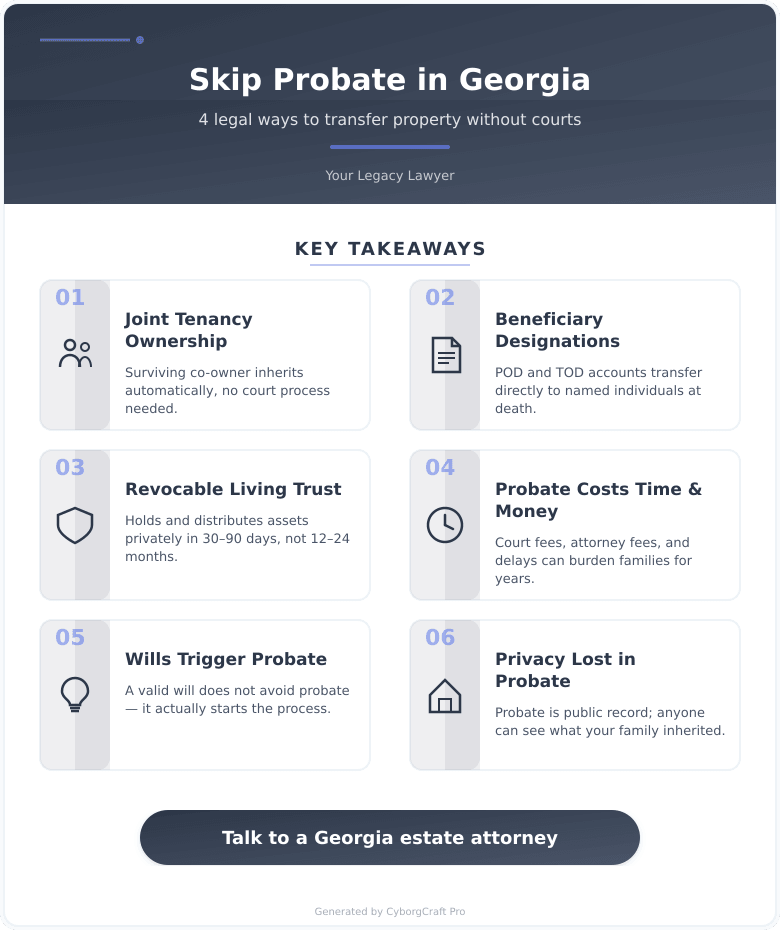
This guide focuses specifically on Georgia residents who want to transfer property after death without probate using legal, proven strategies.
Probate Definition: Probate is the legal process through which a Georgia court validates a deceased person’s will, settles debts, and authorizes the transfer of assets to heirs – a process that can be time-consuming and costly for families who have not planned ahead.
The most common mistake we see is families assuming a valid will keeps them out of probate. It does not. A will actually triggers the probate process in Georgia. The goal is to structure your assets so the will barely matters for property transfer purposes.
Why Georgia Families Want to Avoid Probate
Georgia probate is handled through the Probate Court in each county. Fulton, Cobb, DeKalb, and Gwinnett counties each have their own procedures, timelines, and filing fees. Filing fees, attorney fees, executor fees, and appraisal costs can add up significantly depending on the county and complexity of the estate.
Beyond cost, probate is public. Anyone can look up what your family inherited and from whom. For many Atlanta-area families, that privacy loss is the bigger concern.
Georgia estates going through full probate can take many months to close, particularly when real property or other complexities are involved. That means your heirs cannot access certain assets – including real property – for an extended period in many cases.
The 4 Main Ways to Transfer Property After Death Without Probate
Joint Tenancy with Right of Survivorship
When two people own property as joint tenants with right of survivorship (JTWROS), the surviving owner automatically inherits the deceased owner’s share. No probate needed. This works well for spouses co-owning a home, but it creates complications if the surviving owner later wants to sell or if both owners die simultaneously.
Beneficiary Designations
Bank accounts, retirement accounts (401k, IRA), and life insurance policies all allow you to name a beneficiary directly. These assets pass outside of probate completely. According to the Social Security Administration, beneficiary designations override whatever your will says – which is why keeping them updated matters enormously after divorce, remarriage, or the death of a named beneficiary.
POD (Payable on Death): A designation that allows a bank account balance to transfer directly to a named individual upon the account owner’s death, without court involvement.
TOD (Transfer on Death): Similar to POD but applies to brokerage and investment accounts, allowing securities to transfer automatically to a named beneficiary.
Revocable Trusts
A revocable trust holds your assets during your lifetime and distributes them according to your instructions after death – without probate. You stay in full control while alive. You can change, update, or cancel the trust at any time. The key step most people miss: you must actually transfer your assets into the trust (called “funding” the trust) for it to work. An unfunded trust does nothing.
Georgia Transfer-on-Death Deed
Georgia’s treatment of transfer-on-death deeds for real property differs from some neighboring states that offer this option. This makes trust planning or joint ownership strategies particularly important for Georgia homeowners who want to avoid probate on real estate.
Thinking about which approach fits your situation? Contact us for a straightforward conversation. No pressure, just clear answers.
Probate vs. Trust Administration: Which Approach Works?
| Factor | Georgia Probate | Trust Administration |
|---|---|---|
| Timeline | 12-24 months typical | 30-90 days typical |
| Cost (2026) | 3-8% of gross estate | 1-2% of gross estate |
| Privacy | Public record | Private |
| Court involvement | Required | None |
| Creditor exposure period | 3 months after notice | Varies by structure |
| Best for | Small estates under $10,000 | Homes, investments, families with minor children |
Where probate succeeds: Georgia provides a year’s support procedure and other simplified probate options, but the stated $10,000 small-estate affidavit threshold is not verified and may be inaccurate. An attorney can clarify which simplified procedures apply to your situation.
Where probate fails: Delays asset access, generates public records, and costs significantly more than proactive planning for mid-to-large estates.
Where trust administration succeeds: Fast, private, and cost-effective for families with real estate, investment accounts, or minor beneficiaries.
Where trust administration fails: Requires upfront planning costs and proper asset funding – neither of which happens automatically.
The verdict: For most Georgia families with a home and any meaningful savings, a properly funded revocable trust combined with updated beneficiary designations delivers faster transfers, lower costs, and complete privacy compared to probate.
State Filing Fee Comparison: Georgia vs. Neighboring States (2026)
| State | Probate Filing Fee | TOD Deed Available | Small Estate Threshold |
|---|---|---|---|
| Georgia | $200-$400 (2026) | No | $10,000 |
| Florida | $300-$600 (2026) | No | $75,000 |
| Tennessee | $150-$350 (2026) | Yes | $50,000 |
| Alabama | $100-$300 (2026) | No | $25,000 |
| North Carolina | $120-$400 (2026) | No | $20,000 |
Your Probate Avoidance Action Plan
- Step 1 – Inventory your assets: List every account, property, and policy you own. Note how each one is titled and whether it has a named beneficiary.
- Step 2 – Update beneficiary designations: Review all retirement accounts, life insurance, and bank accounts. Outdated designations are the most common and most costly oversight we see.
- Step 3 – Decide on a trust: If you own real estate or have significant assets, a revocable trust may be the right tool depending on your goals, family structure, and overall estate plan. Consult an attorney before creating one.
- Step 4 – Fund the trust: Work with your attorney to retitle real estate and accounts into the trust. An unfunded trust is just paper.
- Step 5 – Review every 3 years: Life changes – marriage, divorce, new children, asset purchases. Your plan should reflect your current reality.
Documents You Need Before Your Consultation
- ☐ Recent mortgage or property deed for any real estate
- ☐ Most recent statements for bank and investment accounts
- ☐ Life insurance policy declarations pages
- ☐ Existing will or trust documents, if any
- ☐ Retirement account statements (401k, IRA, pension)
- ☐ List of named beneficiaries on each account
Common Mistakes That Send Families to Probate Court
- Relying on a will alone: A will does not avoid probate. It is a set of instructions for probate court, not a substitute for it.
- Forgetting to fund a trust: The trust only controls what is inside it. Real estate and financial accounts must be retitled to the trust.
- Outdated beneficiary designations: A beneficiary who predeceased you, or an ex-spouse listed after divorce, creates a legal tangle that nearly always ends in probate.
- Joint ownership with non-spouses: Adding an adult child to a property deed as joint tenant can trigger gift tax issues and expose your home to their creditors.
Ready to put a real plan together? Contact us and we will walk through your specific assets and the best path forward for your family.
Key Takeaways for Georgia Families in 2026
- A will does not avoid probate – it triggers it. Planning around probate requires different tools entirely.
- Beneficiary designations are powerful – updating them costs nothing and can instantly remove accounts from probate.
- Georgia has no TOD deed option – homeowners need a trust or joint ownership strategy to keep real estate out of court.
- Trusts only work when funded – the most expensive mistake is creating a trust and never transferring assets into it.
- Review your plan regularly – life changes faster than most people update their documents.
Frequently Asked Questions
How do I avoid probate in Georgia without a trust?
You can avoid probate in Georgia without a trust by using beneficiary designations on financial accounts and joint ownership with right of survivorship on real property. These tools work well for straightforward situations, but they have limits – particularly if you want control over how and when heirs receive assets.
How much does it cost to avoid probate in Georgia?
Setting up a basic revocable trust in Georgia typically costs $1,500-$3,500 in attorney fees (2026), compared to $5,000-$15,000 or more for probate on a modest estate. Beneficiary designation updates are usually free through your bank or plan administrator.
Does a will avoid probate in Georgia?
No – a will does not avoid probate in Georgia; it actually initiates the probate process. The court must validate the will before any property transfers can take place, which is exactly what most families are trying to skip.
How long does Georgia probate take without a plan in place?
Georgia probate typically takes 12-24 months for estates with real property or any complexity. Simple estates with few assets and no disputes may close in 6-9 months, but that timeline is not guaranteed.
What assets automatically avoid probate in Georgia?
Assets with named beneficiaries – including life insurance, IRAs, 401ks, and POD/TOD accounts – automatically avoid Georgia probate. Property held as joint tenants with right of survivorship also transfers outside of court.
Do I need an attorney to avoid probate in Georgia?
Beneficiary designations you can update on your own, but creating and funding a trust correctly requires an attorney. Errors in trust drafting or funding are common DIY mistakes that often end up causing the very probate they were meant to prevent. For more guidance, the State Bar of Georgia maintains a lawyer referral service for Georgia residents.
Where does Your Legacy Lawyer serve clients in Georgia?
Your Legacy Lawyer serves families throughout the Atlanta metro area and surrounding Georgia communities. The office is located at 1100 Circle 75 Pkwy, Atlanta, GA 30339, and serves clients across Cobb, Fulton, DeKalb, Gwinnett, Cherokee, and Forsyth counties.
Your Next Step
Most Georgia families do not think about probate until they are already in it – and by then the options are limited. The good news is that transferring property after death without probate is very achievable with the right structure in place today.
Your Legacy Lawyer helps Atlanta-area families build clear, practical plans that keep their assets out of court and in the hands of the people they care about. Visit our services page to learn more about what we do, or get in touch to schedule a consultation. Straight answers, no pressure.