Will vs. Living Trust: Which One Actually Protects Your Family?
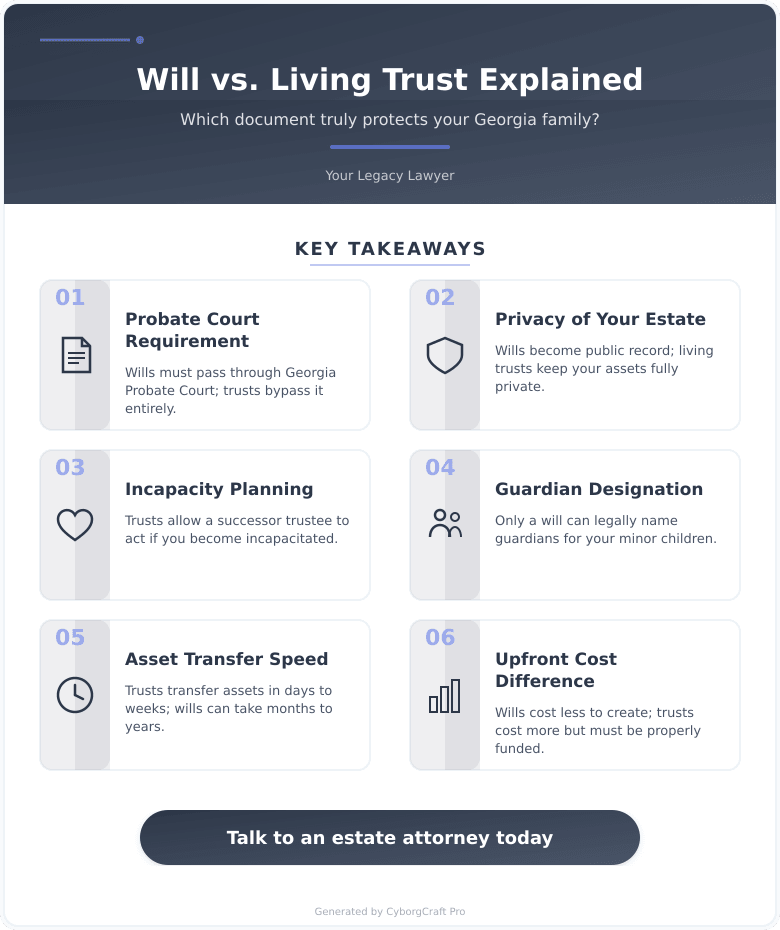

This guide focuses specifically on Georgia residents weighing will vs. living trust options and wanting a clear, honest comparison before meeting with an attorney.
Will vs. Living Trust Definition: A will is a legal document that directs how your assets are distributed after death and must pass through the Georgia probate process, while a living trust is a legal arrangement that holds your assets during your lifetime and transfers them directly to beneficiaries without probate.
Most people assume a will covers everything. The reality is more complicated. Both documents serve important roles, and the right choice depends on your asset types, family situation, and how much privacy and speed matter to your heirs. The most common mistake we see is assuming one document automatically replaces the other.
What a Will Actually Does
A will (formally called a last will and testament) is a written directive that takes effect only after you die. It names an executor to manage your estate, identifies beneficiaries, and can designate guardians for minor children.
Key limitation: A will does not avoid probate. In Georgia, assets that transfer through a will must pass through Probate Court, which is a public, supervised process. Probate timelines vary depending on estate complexity, whether disputes arise, and other factors specific to each case.
- Takes effect only at death
- Requires Georgia probate court oversight
- Becomes a public record once filed
- Can name guardians for minor children
- Lower upfront cost to create
What a Living Trust Actually Does
A revocable living trust is a legal entity you create during your lifetime to hold ownership of your assets. You typically serve as your own trustee while alive and name a successor trustee to manage and distribute assets after your death or incapacity.
Key advantage: Assets held inside a living trust bypass probate entirely. Your successor trustee can transfer property to beneficiaries without court involvement, often within weeks rather than months.
- Effective immediately upon creation and funding
- Avoids Georgia probate court entirely
- Remains private – never becomes public record
- Covers incapacity planning during your lifetime
- Higher upfront legal cost to establish and fund properly
Thinking about which approach fits your situation? Contact us at Your Legacy Lawyer for a straightforward conversation about your options – no pressure, just real answers.
Will vs. Living Trust: Which Approach Works?
| Factor | Will | Living Trust | Best For |
|---|---|---|---|
| Probate Required | Yes (Georgia Probate Court) | No | Trust wins for larger estates |
| Privacy | Public record | Fully private | Trust wins for privacy |
| Upfront Cost (2026) | Generally lower | Generally higher | Will wins for simplicity |
| Incapacity Planning | Does not apply | Covered by trust terms | Trust wins for incapacity |
| Guardian Designation | Yes | No | Will required for minor children |
| Transfer Speed | Months to years | Days to weeks | Trust wins for speed |
Where a will succeeds: Wills cost less upfront, are simpler to create, and are the only vehicle for naming guardians for minor children. For small estates with few assets, a will often gets the job done.
Where a will fails: It requires probate, creates a public record of your estate, and offers no protection if you become incapacitated before death.
Where a living trust succeeds: Trusts avoid probate, keep your financial affairs private, and allow a successor trustee to step in immediately if you become mentally or physically incapacitated.
Where a living trust fails: A trust costs more to establish and only works if you properly fund it – meaning you actually retitle assets into the trust’s name. An unfunded trust is essentially useless.
The verdict: For many Georgia homeowners and families, a living trust paired with a pour-over will can provide broad protection depending on individual goals and circumstances. The pour-over will acts as a safety net, capturing any assets accidentally left outside the trust and directing them into it through probate.
Georgia-Specific Considerations You Should Know
Georgia’s probate process is governed by the Georgia Probate Code under Title 53 of the Official Code of Georgia Annotated. Georgia does offer a simplified “no-administration” probate option for smaller estates, but this is only available under specific conditions and still involves court oversight.
One factor that surprises many Atlanta-area residents: real estate held in your name alone at death must go through probate in Georgia before transferring to heirs. A living trust sidesteps this entirely by holding title to the property during your lifetime.
According to Nolo, Georgia residents with real property, retirement-adjacent assets, or blended families tend to benefit most from a trust-based plan.
Serving clients across the greater Atlanta metro – including Cobb County, Fulton County, Cherokee County, Marietta, Sandy Springs, Smyrna, and surrounding communities – Your Legacy Lawyer sees this question come up constantly. And the answer is almost never one-size-fits-all.
Your Estate Planning Action Plan
- Step 1 – Inventory Your Assets: List everything you own, including real estate, bank accounts, investment accounts, retirement accounts, and life insurance. This tells you how much is actually subject to probate.
- Step 2 – Identify Your Priorities: Decide what matters most – minimizing cost now, protecting privacy, avoiding probate, or planning for incapacity. Your priorities drive the right document choice.
- Step 3 – Consider Your Family Situation: Minor children require guardian designations only a will can provide. Blended families or beneficiaries with special needs often benefit from trust provisions.
- Step 4 – Meet With an Attorney: Georgia law has specific execution requirements for both wills and trusts. A Georgia-licensed attorney ensures your documents are valid and actually enforceable.
- Step 5 – Fund Your Trust (If Applicable): Creating a trust without retitling your assets into it is the most common and costly mistake. Work with your attorney to transfer real property, bank accounts, and other assets into the trust.
Common Mistakes That Derail Estate Plans
- Creating a trust but never funding it – assets left outside still go through probate
- Forgetting to update beneficiary designations on retirement accounts and life insurance
- Using online DIY templates that don’t meet Georgia’s witness and notarization requirements
- Assuming a will alone handles everything – it doesn’t cover incapacity planning
Key Takeaways for Atlanta-Area Residents in 2026
- Wills require probate – Georgia Probate Court is public, time-consuming, and costly for larger estates
- Living trusts bypass probate – assets transfer privately and quickly to your beneficiaries
- Most families need both – a pour-over will paired with a living trust provides the most complete protection
- Funding is critical – a trust that holds no assets provides no benefit at all
- Georgia has specific requirements – document execution rules matter for enforceability
Frequently Asked Questions
What is the main difference between a will and a living trust in Georgia?
A will transfers assets through Georgia’s probate court process, while a living trust transfers them directly to beneficiaries without court involvement. The probate process is public and can take months, while a properly funded trust can distribute assets within weeks.
How much does a living trust cost compared to a will in Georgia?
In Georgia, a living trust generally costs more to prepare than a basic will. These costs vary based on estate complexity and the attorney you work with, so consulting a Georgia-licensed attorney is the best way to get an accurate estimate for your situation.
Does a living trust avoid all probate in Georgia?
A living trust avoids probate only for assets that are properly titled in the trust’s name. Assets left outside the trust at death – like a bank account you forgot to retitle – will still go through Georgia probate unless they have a named beneficiary or joint owner.
Do I still need a will if I have a living trust?
Yes – most estate planning attorneys recommend pairing a living trust with a pour-over will. The will captures any assets accidentally left outside the trust and directs them into it, and it’s the only document that can designate guardians for minor children in Georgia.
Can a living trust be changed after it’s created?
A revocable living trust can be changed, amended, or revoked at any time while you are alive and mentally competent. This flexibility makes it a practical planning tool that adapts to life changes like marriage, divorce, or new assets.
How long does Georgia probate take for a will?
Georgia probate timelines vary depending on the complexity of the estate and whether any disputes arise. Contested estates or those with unclear titles can take significantly longer, which is one reason many families choose a trust to avoid the process entirely.
Is a living trust worth it for a smaller estate?
For smaller estates with limited real property and simple beneficiary designations, a will combined with proper beneficiary designations on financial accounts may be sufficient. The higher upfront cost of a trust makes the most sense when you have significant real estate, privacy concerns, or want to avoid probate delays for your heirs.
Your Next Step Starts Here
Estate planning decisions made without full information can cost your family significantly – in time, legal fees, and stress during an already difficult period. The difference between a will and a living trust is not just a technicality. It shapes everything that happens to your assets and your loved ones after you’re gone.
Ready to get clarity on which approach fits your situation? Contact us today for a direct conversation about your estate plan. The team at Your Legacy Lawyer, serving families throughout the Atlanta, Georgia area, is here to help you make a decision with confidence – not guesswork. For an overview of how we can help, visit our services page.
This content is provided for general informational purposes and does not constitute legal advice. Estate planning laws vary by individual circumstance. Consult a Georgia-licensed attorney for guidance specific to your situation.