What Estate Planning Attorneys Won’t Tell You About Creating a Living Trust

This guide focuses specifically on how to create and fund a living trust in Georgia, including the steps most people skip that make the document useless.
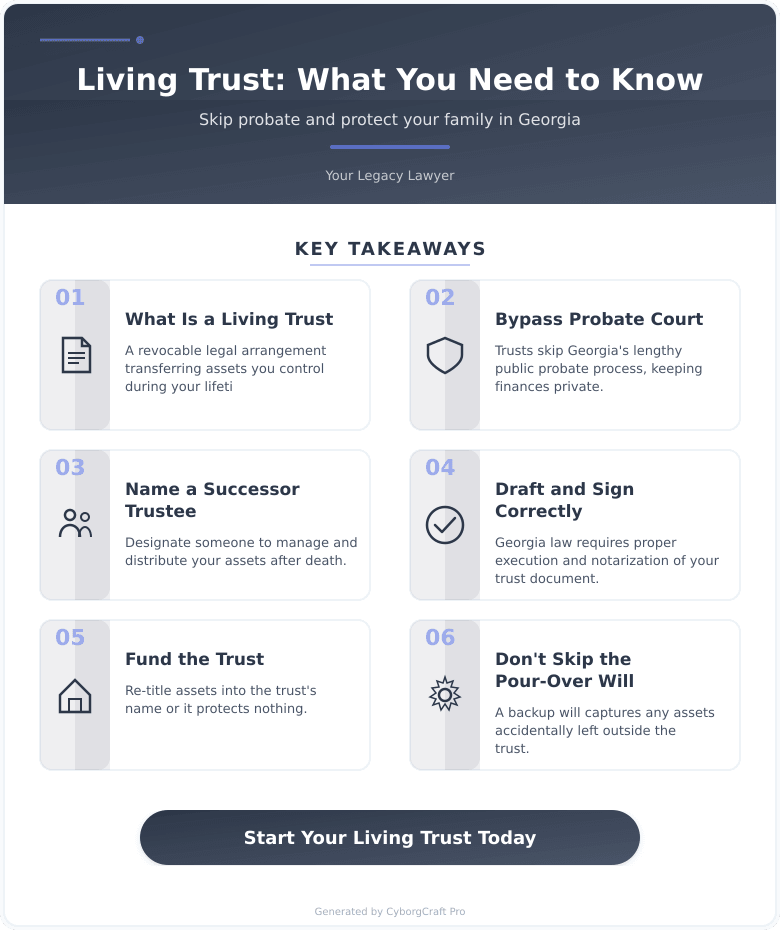
Living Trust Definition: A living trust (also called a revocable living trust) is a legal arrangement where you, as the grantor, transfer ownership of your assets into a trust during your lifetime, name yourself as trustee, and designate a successor trustee to manage and distribute those assets after your death – all without court involvement.
One of the most common mistakes we see is that people create the trust document and then stop there. The trust only works if you actually transfer assets into it. That funding step is where most DIY attempts fall apart.
Why Georgia Residents Are Choosing Living Trusts in 2026
Georgia probate can take considerable time even for straightforward estates, and the process takes longer when family disputes or missing documents slow things down. Probate is a public process, which means your financial details become part of the court record that others can view.
A properly funded living trust bypasses all of that. Your successor trustee handles distribution privately, often within weeks. For Atlanta-area families with property in Cobb County, Fulton County, or DeKalb County, that privacy and speed matters enormously.
Revocable living trust: A trust you can change, update, or revoke at any time while you are alive and competent – giving you full control over your assets throughout your lifetime.
Successor trustee: The person or institution you name to manage and distribute your trust assets after you pass away or become incapacitated.
How to Create a Living Trust: The Step-by-Step Process
Phase 1: Decide on Your Trust Structure (1-2 Weeks)
Most married Georgia couples choose a joint revocable trust, while single individuals use an individual trust. You will name yourself as trustee, designate a successor trustee, and list your beneficiaries – the people who receive your assets.
Key actions during this phase:
- Choose your successor trustee (a trusted family member, friend, or corporate trustee)
- List all assets you plan to transfer into the trust
- Decide on beneficiary designations and any conditions on distributions
Phase 2: Draft and Sign the Trust Document (1-3 Weeks)
The trust document must be properly executed according to Georgia law. Work with a qualified attorney to ensure the document meets all applicable signing and execution requirements, particularly when real property transfers are involved.
Key actions during this phase:
- Work with an attorney or use a reviewed template to draft the document
- Sign and notarize the trust agreement
- Create a pour-over will to capture any assets left outside the trust
Phase 3: Fund the Trust (2-4 Weeks)
This is the step most people underestimate. An unfunded trust protects nothing. You must legally re-title assets from your personal name into the name of the trust.
Key actions during this phase:
- Re-title real estate by recording a new deed at the county courthouse (Cobb, Fulton, DeKalb, or your county of record)
- Change account ownership at your bank or brokerage to the trust name
- Update beneficiary designations on life insurance and retirement accounts to align with your plan
- Transfer vehicle titles if desired (check with your insurance carrier first)
Georgia deed recording fees vary by county. Contact your local county deed office for current fee schedules.
How to Fund a Living Trust: What Goes In and What Stays Out
Knowing how to fund a living trust correctly is just as important as creating it. Here is a practical breakdown.
Assets that belong inside the trust:
- Real estate (primary home, rental properties, vacation property)
- Bank and investment accounts
- Business interests (consult an attorney for LLCs or partnerships)
- Valuable personal property like jewelry or art collections
Assets typically kept outside the trust:
- Retirement accounts (IRAs, 401(k)s) – name the trust as beneficiary instead of retitling
- Life insurance policies – update the beneficiary designation
- Motor vehicles in many cases (title transfers can trigger issues with lenders)
Thinking about this for your situation? Let’s talk. Contact us and we’ll walk you through your options – no pressure, no obligation.
Living Trust vs. Will: Which Approach Works?
| Feature | Living Trust | Last Will and Testament |
|---|---|---|
| Avoids Probate | Yes | No |
| Becomes Public Record | No | Yes |
| Controls Incapacity | Yes | No |
| Requires Funding Step | Yes | No |
| Typical Georgia Cost | Varies by complexity – consult an attorney for current pricing | Varies by complexity – consult an attorney for current pricing |
| Best For | Property owners, blended families, privacy-focused individuals | Younger adults, simple estates, naming guardians for minors |
Where a living trust succeeds: Avoids probate entirely, protects privacy, manages assets during incapacity, and works across multiple states if you own out-of-state property.
Where a living trust fails: Higher upfront cost, requires ongoing maintenance as you acquire new assets, and does not replace a will for naming guardians for minor children.
Where a will succeeds: Lower cost, simpler to create, and the only document that can name a guardian for your children.
Where a will fails: Goes through probate, becomes public, offers no incapacity protection.
The verdict: Most Georgia homeowners benefit from having both – a living trust as the foundation and a pour-over will as a safety net. If you own real estate in Atlanta, Marietta, Smyrna, Roswell, or other Cobb and Fulton County communities, a trust is almost always the stronger choice for avoiding probate delays.
See how our approach can help you decide which tools fit your estate plan.
Common Mistakes That Make a Living Trust Worthless
- Not funding the trust: Signing the document without retitling assets means everything still goes through probate.
- Forgetting to update the trust after major life changes: Marriage, divorce, new property purchases, or the death of a named trustee all require updates.
- Naming the trust as IRA beneficiary without planning: This can create unexpected tax consequences – consult a tax advisor before doing this.
- Skipping the pour-over will: Assets acquired after the trust is created need a safety net to get captured correctly.
Your Living Trust Action Plan
- Step 1 – Inventory your assets: List everything you own – real estate, accounts, business interests, and valuables. This determines what needs to go into the trust.
- Step 2 – Choose your successor trustee: Pick someone organized and trustworthy, or consider a professional corporate trustee for larger or complex estates.
- Step 3 – Draft and notarize the trust document: Work with an attorney familiar with Georgia trust law to ensure the document is valid and tailored to your situation.
- Step 4 – Fund the trust immediately: Re-title real property through your county deed office and update financial accounts without delay.
- Step 5 – Review and update annually: Check that new assets are titled correctly and that beneficiary designations stay consistent with your plan.
Documents to gather before your consultation:
- ☐ Deeds for all real property
- ☐ Recent account statements for bank and investment accounts
- ☐ Life insurance policy details
- ☐ Retirement account beneficiary designations
- ☐ Any existing estate planning documents
- ☐ List of intended beneficiaries with contact information
Key Takeaways for Georgia Residents in 2026
- A living trust only works if it is funded – signing the document is just the beginning.
- Georgia probate is public and slow – a trust bypasses both problems for most assets.
- Most people need both a trust and a pour-over will – one document alone rarely covers everything.
- Funding requires action at the county level – Cobb, Fulton, DeKalb, and Cherokee County deed offices are where real property transfers happen.
- Annual reviews matter – life changes fast, and your trust should keep pace.
Frequently Asked Questions
How much does it cost to create a living trust in Georgia?
The cost of an attorney-prepared living trust in Georgia depends on the complexity of your estate and the attorney you work with. Simple individual trusts generally cost less than joint marital trusts involving multiple properties or business interests. According to the Nolo legal resource library, DIY options exist but carry significant risk if the funding step is handled incorrectly.
How long does it take to create and fund a living trust?
Most living trusts can be drafted, signed, and partially funded within 4 to 8 weeks. Real estate transfers depend on county deed office processing times, which vary across Georgia. Financial institution account retitling can take 1 to 3 weeks per institution.
Does a living trust avoid all probate in Georgia?
A properly funded living trust avoids probate for all assets held in the trust’s name. Assets left outside the trust – like a car titled only in your name or an account you forgot to retitle – will still go through probate unless covered by a pour-over will or beneficiary designation.
Can I be my own trustee?
Yes – in a revocable living trust, you typically serve as your own trustee during your lifetime. You maintain full control over trust assets, can buy and sell property, and can revoke or change the trust at any time. Your successor trustee only takes over when you pass away or become incapacitated.
What happens to my living trust when I die?
At your death, the living trust becomes irrevocable and your successor trustee steps in to manage and distribute assets according to your instructions. No court approval is needed, which means distributions can happen in weeks rather than months.
Do I still need a will if I have a living trust?
Yes – a pour-over will is an essential companion to any living trust. It captures assets accidentally left outside the trust and is the only document that can name a guardian for minor children in Georgia.
Your Next Step
Creating a living trust the right way – and actually funding it – takes careful attention to Georgia-specific rules and your personal financial picture. The families we work with across Atlanta, Marietta, Sandy Springs, Kennesaw, and surrounding communities often tell us they wish they had done this years earlier.
Ready to take the next step? Contact us today for straight answers and real guidance on how to create and fund a living trust that actually works for your family. At Your Legacy Lawyer, we help Georgia residents build estate plans that hold up when it matters most.