Revocable vs. Irrevocable Trusts: Which One Actually Protects Your Assets?
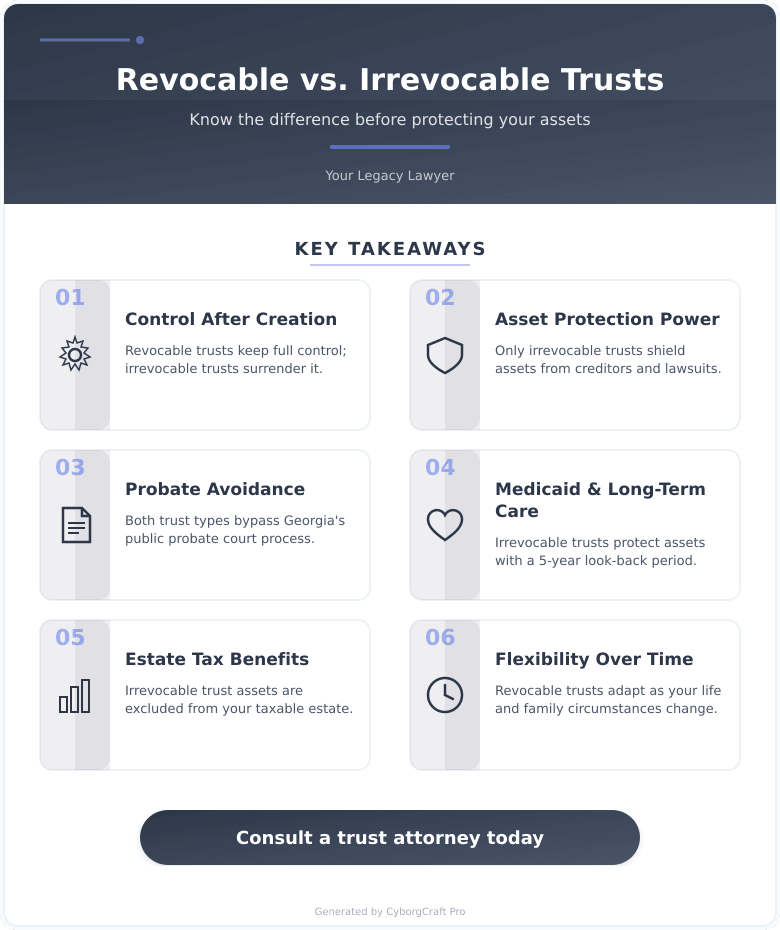
Revocable vs. irrevocable trusts are two distinct legal tools for managing and transferring assets, each offering different levels of control, protection, and tax treatment. Choosing the right one depends on your specific financial goals, family situation, and how much flexibility you need over time.

This guide focuses specifically on helping Georgia residents understand both trust types, compare them side by side, and decide which structure makes sense before meeting with an attorney.
Trust Definition: A trust is a legal arrangement where one party (the grantor) transfers ownership of assets to a trustee, who manages those assets for the benefit of named beneficiaries according to the trust’s terms.
The most common mistake people make is assuming one trust type is universally better than the other. From what experienced trust attorneys see consistently, families come in having already decided on one option based on something they read online – only to discover it conflicts with what they actually need. Getting clear on the differences first saves time, money, and real frustration later.
What Is a Revocable Trust?
A revocable trust – often called a revocable living trust – is a trust you can change, update, or cancel at any time while you are alive. You typically serve as your own trustee, keeping full control over the assets you place inside it. When you pass away, the trust becomes irrevocable, and a successor trustee distributes assets to your beneficiaries without going through probate court.
Revocable trust: A trust that the grantor can amend or revoke at any time during their lifetime, offering full control but limited asset protection.
Here is what makes revocable trusts appealing to most people:
- You keep complete control of your assets during your lifetime
- Assets transfer to heirs without going through Georgia’s probate process
- You can add, remove, or change beneficiaries at any point
- The trust can be updated as your life circumstances change
- It keeps your affairs private since probate records are public
The trade-off is significant though. Because you retain control, the IRS and Georgia creditors still consider those assets yours. That means a revocable trust offers no protection from lawsuits, nursing home costs, or creditors during your lifetime.
What Is an Irrevocable Trust?
An irrevocable trust works differently. Once you transfer assets into it, you generally give up ownership and control. You cannot simply change your mind and take them back. That loss of control is the whole point – because it is what creates legal protection.
Irrevocable trust: A trust that cannot be modified or revoked by the grantor after creation without the consent of the beneficiaries, providing stronger asset protection and potential tax advantages.
Irrevocable trusts are used in several situations:
- Protecting assets from Medicaid spend-down requirements (typically a 5-year look-back period applies in Georgia)
- Reducing taxable estate value for federal estate tax purposes
- Shielding assets from lawsuits and creditor claims
- Preserving wealth for future generations through generation-skipping structures
- Holding life insurance outside your taxable estate (Irrevocable Life Insurance Trust, or ILIT)
According to the Internal Revenue Service, assets properly transferred to an irrevocable trust are generally excluded from the grantor’s taxable estate, which matters once your estate approaches the federal exemption threshold.
Revocable vs. Irrevocable Trusts: Which Approach Works?
| Feature | Revocable Trust | Irrevocable Trust | Best For |
|---|---|---|---|
| Control After Creation | Full control retained | Control surrendered | Revocable: Active asset managers |
| Asset Protection | None during lifetime | Strong protection | Irrevocable: High-liability individuals |
| Probate Avoidance | Yes | Yes | Both work equally here |
| Medicaid Planning | Not effective | Effective with 5-year look-back | Irrevocable: Long-term care planning |
| Tax Benefits | Minimal | Potential estate tax reduction | Irrevocable: Larger estates |
| Setup Cost | Varies by attorney and complexity | Typically higher than revocable trusts | Depends on complexity |
| Flexibility | High | Very low | Revocable: Changing circumstances |
Where revocable trusts succeed: They are simpler, more affordable, and give you complete flexibility. They avoid probate and keep your wishes private without requiring you to give up anything today.
Where revocable trusts fail: They provide zero protection from creditors, lawsuits, or long-term care costs during your lifetime. They also do not reduce estate taxes.
Where irrevocable trusts succeed: They offer genuine asset protection, Medicaid planning benefits, and estate tax reduction for larger estates.
Where irrevocable trusts fail: Once funded, they are difficult to undo. You lose control of those assets, and any changes typically require beneficiary consent or court approval.
The verdict: Most Georgia families with modest estates start with a revocable trust for probate avoidance and flexibility. Irrevocable trusts make more sense when asset protection, Medicaid eligibility, or significant estate tax exposure is the primary concern. Many families ultimately use both – a revocable trust as the core structure and an irrevocable trust for specific assets or goals.
Thinking about this for your situation? Let’s talk. Contact us and we will walk you through your options – no pressure.
Georgia-Specific Considerations
Georgia follows the Uniform Trust Code framework, which governs how trusts are created, administered, and modified in the state. A few Georgia-specific points worth knowing:
- Georgia does not have a state estate tax (as of 2026), so federal exemptions – currently over $13 million per individual – are what matter most for tax planning here
- Georgia Medicaid uses a 60-month (5-year) look-back period when evaluating asset transfers to irrevocable trusts for long-term care eligibility
- Probate in Georgia can take anywhere from 6 to 18 months depending on estate complexity, which is a strong argument for setting up a trust regardless of type
- Georgia requires trusts to be in writing and signed, but does not require notarization for validity – though notarization is still strongly recommended for real estate transfers
For a broader overview of trust law guidance, the Georgia Courts website provides public resources on the state’s probate process and court procedures.
At Your Legacy Lawyer, we work with clients across Atlanta and throughout the metro area – including Cobb County, Fulton County, Cherokee County, Marietta, Sandy Springs, Smyrna, and Kennesaw – to build trust structures that reflect their actual goals, not just generic templates.
Your Trust Planning Action Plan
- Step 1 – Identify your primary goal: Write down whether your main concern is avoiding probate, protecting assets from creditors, Medicaid planning, or reducing taxes. This decision shapes everything else.
- Step 2 – Take inventory of your assets: List everything you own – real estate, bank accounts, investment accounts, retirement accounts, life insurance. Not all assets belong in a trust.
- Step 3 – Choose your trustee: Decide who you trust to manage and distribute your assets. For revocable trusts, this is typically yourself while alive, then a successor. For irrevocable trusts, you will name someone else from day one.
- Step 4 – Name your beneficiaries clearly: Vague beneficiary designations cause disputes. Be specific about who receives what, and under what conditions.
- Step 5 – Fund the trust: An unfunded trust is a useless trust. Work with your attorney to retitle assets into the trust’s name after signing.
- Step 6 – Review periodically: Life changes. Review your trust every 3-5 years or after major life events like marriages, divorces, births, or significant changes in assets.
Common Mistakes That Derail Trust Plans
The most common mistake attorneys see is creating a trust and never funding it. The document sits in a drawer while all assets remain in the owner’s personal name – meaning probate still applies to everything. Another frequent error is choosing an irrevocable trust to qualify for Medicaid without accounting for the 5-year look-back, which can leave families in a worse position if the timing is off. A third mistake is naming a trustee without having an honest conversation with that person first. Surprises after death create conflict. And finally, people often try to handle complex irrevocable trust structures without an attorney to save money, then face significant legal fees correcting errors later.
Ready to take the next step? Contact us today for straight answers and real guidance on which trust structure fits your situation in Georgia.
Key Takeaways for Georgia Residents in 2026
- Revocable trusts offer flexibility – you keep control and can update them anytime, but they do not protect assets from creditors
- Irrevocable trusts offer protection – you give up control in exchange for shielding assets from lawsuits, Medicaid spend-down, and estate taxes
- Both types avoid probate – which matters in Georgia where probate can take over a year
- Georgia has no state estate tax – so tax planning here focuses on federal thresholds
- Funding is non-negotiable – a trust that holds no assets accomplishes nothing
Frequently Asked Questions
What is the main difference between a revocable and irrevocable trust?
The core difference is control – with a revocable trust you keep it, with an irrevocable trust you give it up. That surrender of control is what creates asset protection and potential tax benefits in an irrevocable trust, while a revocable trust simply manages and transfers assets on your terms.
Can I change an irrevocable trust after it is created?
Generally no – that is the defining feature of an irrevocable trust. In some cases, beneficiaries can consent to modifications, or a court may allow changes under specific circumstances, but this is not guaranteed and can be costly.
Does a revocable trust protect assets from nursing home costs in Georgia?
No – a revocable trust does not protect assets from Medicaid spend-down requirements. Because you retain control, Georgia Medicaid counts those assets as yours. An irrevocable trust, funded at least 5 years before applying for Medicaid, is the appropriate tool for long-term care planning.
How much does it cost to set up a trust in Georgia?
The cost to set up a trust in Georgia varies based on the attorney, the complexity of the plan, and the assets involved. Irrevocable trusts generally require more planning and tend to cost more than revocable trusts. An attorney can provide a fee estimate after reviewing your specific situation.
Do I still need a will if I have a trust?
Yes – most attorneys recommend a pour-over will alongside any trust. A pour-over will captures any assets you forgot to transfer into the trust and directs them into it at death, ensuring nothing falls outside your plan.
How long does it take to create a trust in Georgia?
A straightforward revocable trust can typically be drafted and signed within 2-4 weeks of a consultation. Irrevocable trusts with more complex planning goals may take 4-8 weeks. Funding the trust – retitling assets – adds additional time depending on the types of property involved.
What happens to a revocable trust when I die?
At death, a revocable trust automatically becomes irrevocable and the successor trustee takes over. That trustee then distributes assets to your beneficiaries according to the trust terms, bypassing probate entirely.