Healthcare Directives and HIPAA Forms: What Georgia Families Get Wrong
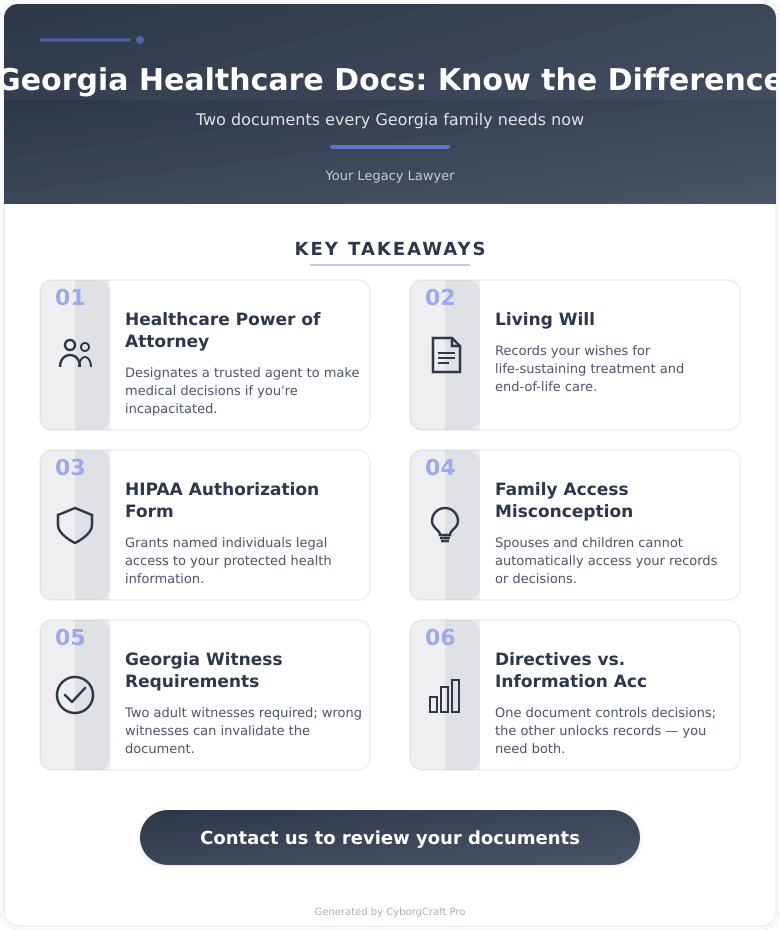
Healthcare directives and HIPAA authorization forms are legal documents that control who makes your medical decisions and who can access your health information when you cannot speak for yourself. Without them in place, your family may face locked medical records, delayed treatment decisions, and avoidable legal conflict.
This guide focuses specifically on Georgia residents who need to understand healthcare directives and HIPAA authorization forms before a medical crisis forces the issue.
Healthcare Directive Definition: A healthcare directive is a legally binding document that records your medical treatment preferences and designates a trusted person to make health decisions on your behalf if you become incapacitated.
Most people assume their spouse or adult child can automatically manage their medical care during an emergency. That assumption is wrong. Under Georgia law, hospitals and physicians are bound by strict privacy rules. A family member with no legal authority may be turned away from critical conversations with your care team. According to the U.S. Department of Health and Human Services, HIPAA rules restrict the release of protected health information even to close family members without proper authorization.
The most common mistake we see is families treating these two documents as interchangeable. They are not. One governs decisions. The other governs information. You need both.
What Is a Healthcare Directive in Georgia?
Georgia recognizes two core documents under its advance directive law: the healthcare power of attorney and the living will (sometimes called a directive to physicians). Together, these form what is broadly called a healthcare directive or advance directive.
Healthcare Power of Attorney: A document designating a specific person, called your healthcare agent, to make medical decisions on your behalf if you lose the ability to make them yourself.
Living Will: A written statement of your wishes regarding life-sustaining treatment, resuscitation, and end-of-life care. It guides your healthcare agent and your physicians when you cannot communicate.
Georgia law requires healthcare directives to be signed by the principal and witnessed by two adults; notarization is not required for validity under the source provided. The witnesses cannot be your healthcare agent, your physician, or anyone who stands to inherit from you. These rules exist to prevent undue influence, and getting them wrong can render the document invalid.
Many adults across the United States do not have a completed advance directive on file with their healthcare provider. That gap creates real consequences for families navigating a medical crisis in 2026.
What Is a HIPAA Authorization Form?
HIPAA Authorization Form: A signed document that gives a named individual permission to receive your protected health information from doctors, hospitals, insurers, and other covered healthcare entities.
The Health Insurance Portability and Accountability Act (HIPAA) restricts who can access your medical records. Even your adult child cannot demand your diagnosis from a treating physician without written authorization. A healthcare power of attorney grants decision-making authority, but it does not automatically unlock your full medical records for every provider.
A HIPAA release form fills that gap. It is typically a shorter document than a healthcare directive, but it is equally important. Without it, your designated agent may be making decisions with incomplete information because providers cannot legally share your records with them.
Think of it this way: the healthcare directive gives your agent the wheel. The HIPAA authorization gives them the map.
Thinking about this for your situation? Contact us and we will walk you through your options with no pressure.
Healthcare Directive vs HIPAA Authorization: Which Approach Works?
| Feature | Healthcare Directive | HIPAA Authorization |
|---|---|---|
| Primary Purpose | Authorizes medical decision-making | Authorizes access to health records |
| Georgia Requirements | Signed, notarized, 2 witnesses | Signed by patient; specific disclosures required |
| Who It Affects | Physicians, hospitals, care teams | All covered healthcare entities |
| When It Activates | Upon incapacity | As specified in the form (can be immediate) |
| Typical Cost Range | Varies depending on attorney and scope of services | Often included in broader document package |
| Best For | Long-term incapacity planning | Immediate and ongoing records access |
Where healthcare directives succeed: Clear decision-making authority during surgery, sudden illness, or end-of-life care. Legally enforceable in Georgia courts.
Where healthcare directives fail: They do not independently unlock medical records from every provider. They require strict execution formalities that DIY versions often miss.
Where HIPAA authorization forms succeed: Immediate, flexible access to records across multiple providers. Can cover specific timeframes or be broad in scope.
Where HIPAA authorization forms fail: They do not grant decision-making authority. A HIPAA form alone will not let your family direct your care.
The verdict: Both documents serve distinct legal functions. Georgia families who prepare only one are leaving a critical gap in their planning. The two documents work together as a complete package.
Your Healthcare Document Action Plan
- Step 1 – Choose Your Healthcare Agent: Select a trusted adult who understands your values and can advocate firmly under pressure. Discuss your wishes with them directly before signing anything.
- Step 2 – Document Your Treatment Preferences: Decide your position on resuscitation, ventilators, feeding tubes, and hospice care. Your living will communicates these preferences when you cannot.
- Step 3 – Draft the Healthcare Power of Attorney: Work with a Georgia attorney to draft a compliant document. Georgia has specific statutory language and execution requirements that matter in practice.
- Step 4 – Execute the Documents Correctly: Sign in front of two qualifying witnesses and a notary. Skipping any step can invalidate the document when it is needed most.
- Step 5 – Complete a HIPAA Authorization Form: Name the individuals who should have access to your medical records. Specify the scope and any time limits.
- Step 6 – Distribute Copies: Give copies to your healthcare agent, your primary care physician, and any professionals. Store originals somewhere accessible, not locked in a safe deposit box no one can open in an emergency.
See how Your Legacy Lawyer approaches document planning for Atlanta-area families – visit our homepage or explore our services for a full overview.
Common Mistakes That Cause Problems
- Naming a healthcare agent without telling them or discussing your wishes
- Using a generic online template that does not meet Georgia’s witness and notarization rules
- Failing to update documents after a divorce, death of the named agent, or major health change
- Storing documents in a location no one can access during an emergency
- Skipping the HIPAA authorization and assuming the healthcare directive covers everything
Firms that take a complete approach to these documents – reviewing them together rather than in isolation – typically see far fewer gaps when documents are actually tested by a real medical event.
Georgia-Specific Considerations in 2026
Georgia’s advance directive law is codified under O.C.G.A. Section 31-32. The state uses a combined advance directive form that merges the healthcare power of attorney and living will into a single document, though you may also use separate instruments. As of early 2026, Georgia does not require periodic renewal of advance directives, but reviewing them every three to five years is a sound practice – especially after major life changes.
Residents of the Atlanta metro area, including Cobb County, Fulton County, Cherokee County, Marietta, Smyrna, Sandy Springs, Kennesaw, and surrounding communities, should ensure their documents are accessible to providers in the local hospital networks, including large regional systems that have their own intake procedures for advance directives.
According to the Georgia Advocacy Office, individuals with properly documented healthcare directives experience significantly fewer family disputes and delays during medical crises than those without them.
Key Takeaways for Georgia Residents in 2026
- Healthcare directives and HIPAA forms are separate documents – one handles decisions, the other handles information access.
- Georgia law has specific execution requirements – two witnesses, notarization, and qualifying witness rules all apply.
- Your healthcare agent needs both authority and access – without a HIPAA form, they may make decisions blind.
- Generic online templates carry real risk – a document that fails Georgia’s formalities is worthless in a crisis.
- Review your documents after major life changes – divorce, death of a named agent, or a new diagnosis all warrant a review.
Frequently Asked Questions
What is a healthcare directive?
A healthcare directive is a legal document that records your medical treatment preferences and names a person to make health decisions for you if you cannot. In Georgia, it typically includes both a healthcare power of attorney and a living will, and must be properly signed, witnessed, and notarized to be enforceable.
What is a HIPAA authorization form?
A HIPAA authorization form is a signed document allowing named individuals to receive your protected health information from healthcare providers. Without it, even a family member acting as your healthcare agent may be legally barred from accessing your full medical records.
Do I need both a healthcare directive and a HIPAA authorization?
Yes – both documents serve different functions and you need both for complete protection. The healthcare directive grants decision-making authority, while the HIPAA authorization grants access to the medical information needed to make those decisions wisely.
How much does it cost to prepare these documents in Georgia?
Attorney-prepared healthcare directives in Georgia are priced according to the scope of services and the attorney you work with, and many attorneys bundle them with broader planning packages. HIPAA authorization forms are often included in that package. Fees vary by firm and by the complexity of your planning needs.
Can I write my own healthcare directive in Georgia?
Georgia does permit self-prepared advance directives, but execution errors are common and can make the document unenforceable. Missing a witness signature, using a disqualified witness, or skipping notarization are mistakes that often appear in DIY documents and are only discovered during a crisis.
What happens if I become incapacitated without a healthcare directive in Georgia?
If you have no healthcare directive, Georgia courts may need to appoint a guardian to make medical decisions for you, which takes time and money your family may not have. Even close family members may disagree on the right course of action, and providers cannot act without lawful authority.
How often should I update my healthcare directive?
Most planning professionals recommend reviewing your healthcare directive every three to five years or after any major life change. Divorce, the death of your named agent, a significant new diagnosis, or a change in your personal values about end-of-life care are all strong reasons to revisit the documents.
Your Next Step
Getting these documents right matters more than most people realize until it is too late. If you are in the Atlanta area – whether in Cobb County, Marietta, Smyrna, or anywhere in the surrounding metro – the time to prepare is before you need them.
Ready to take the next step? Contact us today for straight answers and real solutions. We will review your situation, explain your options clearly, and help you put the right documents in place before a crisis forces your family to figure it out without a plan.
Disclaimer: This content is provided for educational purposes and does not constitute legal advice. Consult a licensed Georgia attorney for guidance specific to your situation.