Trustee vs. Executor: Two Roles, One Wrong Choice Can Cost Your Family Everything
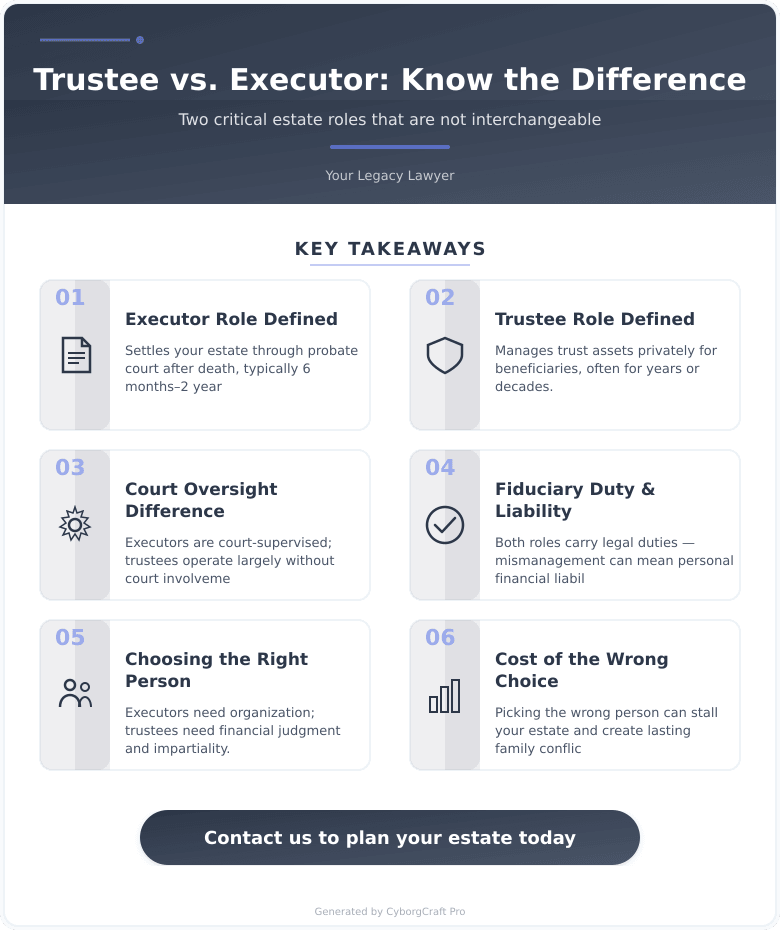
A trustee vs. executor comparison is a common question in legacy planning because the two roles sound similar but carry entirely different responsibilities, timelines, and legal obligations. Picking the wrong person for either role can stall your estate, create family conflict, and expose assets to avoidable risk.

Understanding the practical differences between a trustee and an executor is an important part of sound estate planning, and choosing the right person for each role is a decision that deserves careful thought.
Trustee vs. Executor Definition: An executor (sometimes called a personal representative in Georgia) is appointed to settle a deceased person’s estate through probate court, while a trustee manages assets held inside a trust, often for years or decades, without court supervision.
The most common mistake families make is treating these roles as interchangeable. They are not. One role is temporary and court-supervised. The other is ongoing and largely private. Both carry legal duties that the wrong person can fail to meet – and that failure affects your beneficiaries, not just your paperwork.
What an Executor Actually Does
Executor definition: The executor is the person named in your will to settle your affairs after death through the Georgia probate process.
The Georgia probate process can take anywhere from a few months to several years, depending on estate complexity. During that time, an executor must:
- File the will with the probate court in the county where you resided
- Notify creditors and settle outstanding debts
- Collect and inventory all probate assets
- File any required tax returns, including the final income tax return
- Distribute remaining assets to beneficiaries according to the will
Executors must comply with strict fiduciary duties throughout probate. Mishandling estate funds, even accidentally, can expose an executor to personal liability.
Executors deal with banks, creditors, tax agencies, and courts. The job demands organization and follow-through more than financial sophistication.
What a Trustee Actually Does
Trustee definition: A trustee is the person or institution responsible for managing trust assets according to the terms of a trust document, for the benefit of named beneficiaries.
Unlike an executor, a trustee operates outside of probate court. The role can last years or even decades – particularly when a trust is designed to support minor children until they reach adulthood, or to provide ongoing income for a surviving spouse.
A trustee’s responsibilities include:
- Managing and investing trust assets prudently
- Making distributions to beneficiaries per the trust terms
- Filing annual trust tax returns (Form 1041 if the trust generates income)
- Keeping detailed records of all transactions
- Communicating regularly with beneficiaries
- Acting impartially when trust terms benefit multiple parties
Georgia has adopted a trust code consistent with the Uniform Trust Code framework, but it was not first adopted in 2025. This framework holds trustees to a high legal standard. A trustee who mismanages assets or shows favoritism can be removed and held personally liable for losses.
Want to explore which of these roles applies to your situation? Contact us and we will walk you through your options – no pressure.
Trustee vs. Executor: Which Approach Works?
| Factor | Executor | Trustee |
|---|---|---|
| Duration | 6 months – 2 years | Years to decades |
| Court oversight | Yes (Georgia probate court) | Generally none |
| Primary skill needed | Organization, follow-through | Financial judgment, impartiality |
| Compensation | Reasonable fee, approved by court | Stated in trust document or statute |
| Best candidate | Trusted family member or friend | Professional or financially savvy individual |
| Neighboring state comparison | Similar probate process in FL, TN, SC, AL, NC | Trust law varies – GA is trustee-friendly |
Where an executor succeeds: The role is time-limited and court-guided, so a trustworthy family member with basic organizational skills can do it well. There are built-in checkpoints that reduce risk.
Where an executor fails: Executors who avoid probate court deadlines, mix estate funds with personal funds, or fail to notify creditors properly can create expensive legal problems for beneficiaries.
Where a trustee succeeds: A qualified trustee provides long-term asset protection, consistent distributions, and financial management without dragging beneficiaries through court repeatedly.
Where a trustee fails: A trustee who plays favorites, invests recklessly, or ignores record-keeping requirements can devastate a trust over time – often before anyone notices the problem.
The verdict: Choose your executor based on reliability and honesty. Choose your trustee based on financial judgment and the ability to stay impartial across years of family complexity. These qualities rarely live in the same person.
See how our services can help you structure both roles correctly from the start.
How to Choose an Executor: A Practical Framework
The pattern seen most often in failed estate administrations is an executor chosen for sentimental reasons rather than practical ones. Loving someone and being qualified to settle their estate are different things.
Use this framework when choosing your executor:
- Step 1 – Test organizational capacity: Can this person manage paperwork, meet deadlines, and follow up with institutions for months at a time? If they struggle with their own finances, the answer is probably no.
- Step 2 – Check for conflicts of interest: Is this person also a major beneficiary? Competing interests create friction. A neutral party sometimes works better.
- Step 3 – Have the conversation first: Never name an executor without asking them. The role is demanding, and consent matters.
- Step 4 – Name an alternate: Life changes. Your executor might predecease you or become unable to serve. Always designate a backup.
- Step 5 – Consider a professional executor: For complex estates, a bank trust department or licensed fiduciary removes family tension and brings professional accountability.
How to Choose a Trustee: What Most People Get Wrong
The most common mistake is naming the same person as both trustee and primary beneficiary. This creates a conflict the trust document itself cannot fully resolve. Georgia trust law allows co-trustees, which can balance authority between a family member and a professional institution.
Strong trustee candidates share these qualities:
- Comfort with financial statements and investment decisions
- Ability to stay neutral when beneficiaries disagree
- Willingness to serve for potentially decades
- Geographic stability and availability
- Familiarity with fiduciary duty under Georgia law
Corporate trustees (such as bank trust departments) charge annual fees typically ranging from 0.5% to 1.5% of assets under management (2026 general industry range). That cost often pays for itself through professional investment management and conflict elimination.
Common Mistakes That Create Problems Later
- Choosing based on birth order: Naming the oldest child as executor is tradition, not strategy. Capability matters more than hierarchy.
- Skipping the conversation: Surprising a trustee or executor with the role after death guarantees delays and potential refusals.
- No successor named: If your first choice cannot serve and you named no backup, Georgia courts will appoint someone – often not who you would choose.
- Assuming the same person can do both: Some estates and trusts work fine with one person in both roles. Many do not. Evaluate each role separately.
Key Takeaways for Georgia Residents in 2026
- Executors are temporary. The role ends when probate closes, usually within one to two years in Georgia.
- Trustees serve long-term. Trustee duties can last decades and require sustained financial judgment.
- Both carry legal liability. Mistakes by either role can result in personal financial exposure under Georgia law.
- Professional options exist. Corporate trustees and professional executors are legitimate choices, especially for complex or high-conflict situations.
- Name your alternates. Always designate successor trustees and executors in your documents – this single step prevents enormous disruption.
At Your Legacy Lawyer, serving clients in Atlanta, GA and surrounding communities including Marietta, Smyrna, Vinings, Sandy Springs, and Cobb County, we help families think through exactly these decisions before they become crises.
Frequently Asked Questions
What is the main difference between a trustee and an executor?
An executor handles the probate process after death, while a trustee manages assets inside a trust, sometimes for decades. Executors work under court supervision and their role ends when the estate closes. Trustees operate privately and answer to the trust document and beneficiaries.
Can the same person be both trustee and executor?
Yes, the same person can legally serve as both trustee and executor in Georgia. Whether that is practical depends on the estate’s complexity and whether conflicts of interest exist between the trust beneficiaries and the probate estate.
How do I choose an executor in Georgia?
Choose an executor based on organizational reliability, honesty, and the ability to follow through over months of administrative work. Always ask the person in advance, name an alternate, and consider a professional executor for complicated estates.
How do I choose a trustee for a long-term trust?
Choose a trustee with strong financial judgment, the ability to stay impartial across years, and a genuine willingness to serve long-term. For trusts holding significant assets or involving family conflict, a corporate trustee eliminates bias and brings professional accountability.
What does a trustee get paid in Georgia?
Georgia law allows trustees to receive reasonable compensation, which the trust document typically defines. Corporate trustees generally charge 0.5% to 1.5% annually based on assets managed (2026 general industry range). Individual trustees are often paid an hourly rate or flat annual fee.
What happens if my executor or trustee can’t serve?
If no successor is named, Georgia probate courts will appoint a personal representative, which can delay administration significantly. Always name at least one alternate for both roles in your planning documents to avoid court intervention.
Does Georgia require an executor to post a bond?
Georgia probate courts may require executors to post a surety bond unless the will waives that requirement. Waving the bond requirement in your will saves the estate money and speeds up the process – something worth discussing with a qualified attorney.
Your Next Step
The right trustee and executor do not have to be the same person, and they probably should not be. These are two distinct jobs requiring different skills and different commitments. Getting it right matters – for your beneficiaries, your assets, and the family relationships that survive you.
According to the Nolo legal resource library, executor and trustee disputes are among the leading causes of probate delays and trust litigation nationwide. Thoughtful selection is one of the simplest ways to protect your family from that outcome.
Ready to take the next step? Contact us today for straight answers and real solutions. The sooner these roles are properly assigned in your documents, the less your family will have to figure out later.